Wednesday, October 14, 2020

Comment du Jour


German Reunification’s Peaceful Lesson


Germany’s reunification is now history.  It seemed not so long ago that the Berlin Wall had fallen in 1989, Central European countries had regained their sovereignty through the freedom tsunami sweeping Europe, and unimaginably on 3 October 1990, West and East Germany, the front line frontier of a very Cold War had reunified in peace and freedom.  


Almost as in a fairytale the two separate states, the Federal Republic of Germany

(West) and the communist German Democratic Republic (East), had almost magically merged into one nation without violence, with the legal blessing of the WWII Allied powers, and through the political foresight of German Chancellor Helmut Kohl.   


Perhaps the most enduring image of divided Germany stood as the Berlin Wall, built in 1961.


The Wall separated free West Berlin controlled by the Americans, British and French from Soviet controlled East Berlin.  The Wall provided a vivid juxtaposition of a divided land; it was designed to keep people inside the worker’s paradise and stop others from trying to flee. 


Indeed between 1949 and 1961 over 2.7 million people fled East Germany for the West.  In Berlin itself over 171 were killed at the Wall while escaping. 


I first visited the divided German capital in the late 1970’s; the once grand cosmopolitan city  remained a stunning tableaux in black and white. While the Wall brutally separated families and neighbors, it equally illuminated the vivid contrast between prosperous West Berlin and the grey, dreary and shoddy East Berlin.  


Though the same people, West and East Germany had fundamentally different state personalities; the Federal Republic was aligned with the West, politically free and with a prosperous turbo-charged market economy.  East Germany was the poor cousin steeped in socialism, and part of the Soviet sphere.  


Complicated economic and social comparisons aside, there’s a novel way to understand the contrast between West and East Germany; their celebrated automobiles.  West Germany was known for its iconic Mercedes-Benz cars and trucks.  East Germany sported the Trabant, a small fiberglass 25 horsepower auto which chugged along belching a blue-grey smoke. Citizens in  West Germany’s consumer society had access to the Mercedes line and it was not uncommon to own one.  In the East there was a multi-year waiting list to buy a treasured Trabi—which came in the dazzling colors of white, penicillin green and black.  Enough said!


In June 1987, President Ronald Reagan, while visiting Berlin and speaking at the Brandenburg Gate demanded, “Mr. Gorbachev Tear down this Wall.”  Reagan’s comments touched off a     cascade of shock, criticism, and condescension and from a political class who viewed the      president’s call as an incendiary challenge to an accepted status quo; the Wall. Elites cringed.


But then came the unexpected Freedom Tsunami of Autumn 1989 when Central Europe changed. 


By 1990, the geopolitical stars were aligned perfectly as the four Allied powers, the victors over Naziism in WWII,  acted as cautious midwives to the creation of a reunited Germany.  


Though economically costly, Kohl’s political choice for unity was the right one.  But despite the progress, there’s still political angst among the 17 million Easterners; some speak of a psychological divide between East and West Germany.


Emily Haber, Germany’s  Ambassador to the United States stresses, “The trust and friendship of our neighbors and allies, first and foremost the U.S., helped bring about this unique success    story.  We will never forget America’s support. Thirty years later, we celebrate that historic day and say, ‘Danke!’ to the American people.”


Reunification’s success was anchored in close and enduring Transatlantic ties; let’s refocus on renewing those vital links of friendship.


Friday, October 2, 2020

Comment du Jour


COVID Crisis Clouds United Nations Assembly


Since March the world has been battered by the Covid-19 virus.  Nearly a million people have died and many more been sickened by this “invisible enemy.”  From its origins in China, through its spread into Europe, the United States and Latin America, the virus has ravished societies and rocked the social bedrock of countries round the world.


The annual UN General Assembly, celebrating its 75th anniversary,  has been forced to meet virtually, with online video sessions replacing the diplomatic pomp and pageantry of years past.  


“In a world turned upside down, this General Assembly Hall is among the strangest sights of all,” lamented UN Secretary General Antonio Guterres.  


Here are a few of the more interesting speeches.


Britain’s bombastic Prime Minister Boris Johnson to liven up what’s largely been a droning video debate;  “Never in the history of our species, not since the almighty felled the tower of babel,  has the human race been so obsessed with one single topic of conversation…  COVID-19, coronavirus, has united humanity as never before.”


Boris Johnson then warned, the crisis has also been an extraordinary force for division. We have all been up against the same enemy. The same tiny opponent threatening everyone in much the same way, but members of the UN have still waged 193 separate campaigns, as if every country somehow contains a different species of human being.”


He counseled, “After nine months of fighting COVID-19, the very notion of the international community looks, frankly, pretty tattered. And we know that we simply can’t continue in this way.” That is Unless we get our act together. Unless we unite and turn our fire against our   common foe, we know that everyone will lose.”  


Boris Johnson pledged the United Kingdom’s massive additional funding for the controversial World Health Organization as well as to global vaccine research and distribution efforts. 


Interestingly earlier in the year Prime Minister Johnson was himself hospitalized for having   contracted the Corona virus.  Moreover even today the UK has a proportionally higher Corona virus fatality rate than the United States.


India’s Prime Minister Narendra Modi offered some controversy; “Over the last 8 to 9 months, the whole world has been battling the pandemic of the Coronavirus. Where is the United Nations in this joint  fight against the pandemic? Where is its effective response?”


He added “Reform in the responses, in the processes, and in the very character of the United Nations is the need of the hour.”


Prime Minister Modi then recited a long litany of India’s historic contributions to the UN, but then asked rhetorically why India has not been awarded a permanent seat on the powerful fifteen  member Security Council?  


He said,  “the international community today is faced with a very important question: Whether the character of the institution, constituted in the prevailing circumstances of 1945, is relevant even today?”


India has been devastated by the virus; with almost six million cases, nearly 100,000 people have died.   


Charles Michel of the European Union (EU) made an interesting observation “I have often been asked a question:  In the new rivalry between the United States and China, which side is the European Union on?”


He stated, “My answer is the following...We are deeply connected with the United States. We share ideals, values and a mutual affection that have been strengthened through the trials of history. They remain embodied today in a vital transatlantic alliance.” 


Michel added, “We do not share the values on which the political and economic system in China is based. And we will not stop promoting respect for universal human rights. Including those of minorities such as the Uighurs or in Hong Kong.”


Czech Prime Minister Andrej Babis was one of the few leaders to courageously criticize the WHO; “Unfortunately, and I say it with regret, the response we have seen by the World Health Organization has failed to exercise global health leadership. It did not act resolutely after the pandemic outbreak in Wuhan, China, and had a very limited success – to put it softly – in helping countries prevent, protect against, and respond to disease events.” 


Contrary to past Assembly sessions speakers did not cite the political laundry list of world crises; Korea was barely mentioned,  there were ritualistic mentions of  the Two State solution for Israel and Palestine, and few countries such as the USA, cited human rights in Cuba and Venezuela.    


The Covid crisis has clouded the enthusiasm from this year’s anniversary General Assembly.  


But it’s oft darkest before the dawn.


Thursday, September 24, 2020

Comment du Jour


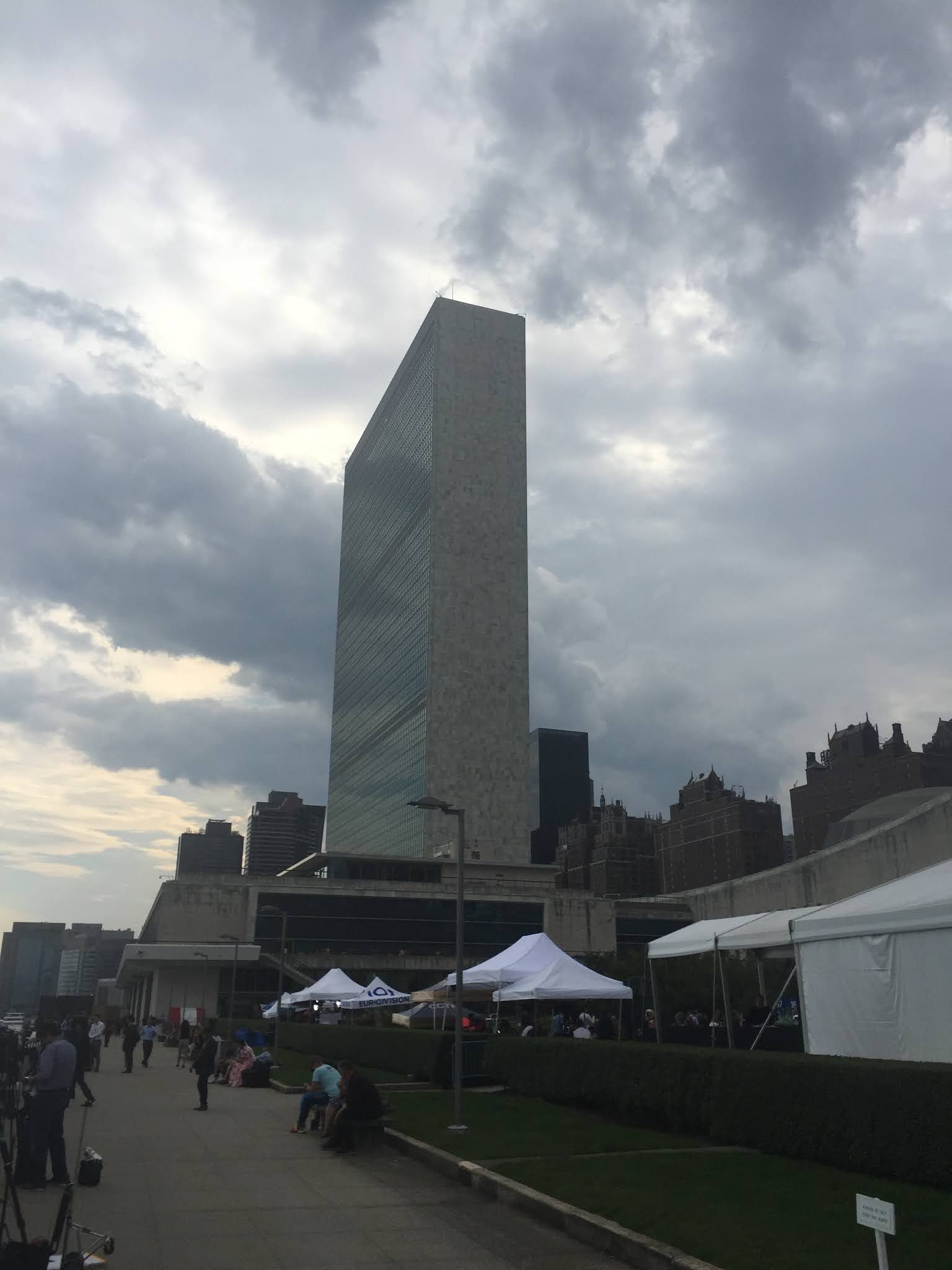
 UN General Assembly Opens in New York—But Online


Presidents, Prime Ministers and Kings are attending the opening debate of the UN General Assembly; but online. The 75th anniversary session of the Assembly was planned as a gala gathering of chiefs of state and government but shall now be relegated to a series of virtual sessions. 


The cavernous General Assembly hall shall resonate not with live speeches, applause, and the stir of anxious delegates, but with prerecorded fifteen minute presentations.  


During this annual rite of Autumn in New York, the delegates, the motorcades, the speeches, the hyper security and the traffic jams, has succumbed to the Covid pandemic. How the world has so quickly changed!


The UN celebrates its founding in 1945 when the Allied victors of WWII, Britain, China, France, the Soviet Union and the United States founded the multinational world assembly.  At its creation the UN had 51 countries; today there are 193 member states.  


Nonetheless despite the pandemic challenges, the United Nations faces daunting missions     ranging from enduring conflicts in Syria and Yemen, humanitarian crises from the Congo to Lebanon and Venezuela, and the widening socio-economic disaster caused by the global spread of Covid-19.   


UN Secretary General Antonio Guterres told correspondents “The COVID-19 pandemic is a   crisis unlike any in our lifetimes, and so this year’s General Assembly session will be unlike any other, too.”   He added, “the stakes could not be higher.  Our world is nearing the grimmest of milestones:  1 million lives lost to the virus.  Meanwhile, the outbreak remains out of control.”


The general debate session leads off by tradition with Brazil as the first speaker followed by the  United States.  President Donald Trump’s video address rocked the largely empty Assembly Hall by clearly pinning the Covid-19 outbreak on China. The President stressed, “we must hold accountable the nation which unleashed this plague onto the world: China.”


Following the USA, the diplomatic speakers lineup included the Presidents of Turkey, China, Russia, South Korea, Islamic Iran and France among others conducting digital diplomacy!  


Thus contrary to the norm there will be none of the usual mingling, handshakes and diplomatic bonhomie which characterizes UN sessions.  I’ve been covering these events long enough to   appreciate that the real diplomacy transpires at receptions, bilateral meetings and behind the scenes impromptu chats.   


Speaking bluntly about a Covid vaccine Secretary General Guterres warned, “Many pin their hopes on a vaccine—but let’s be clear: there is no panacea in a pandemic.”  


“But, starting now, a vaccine must be seen as a global public good, because COVID-19 respects no borders.  We need a vaccine to be affordable and available to all,” Guterres stressed adding, “For any vaccine to work, people across the globe need to be willing to take it.  But, with the spread of the virus, we are also seeing a proliferation of misinformation about a future vaccine.  This is fueling vaccine hesitancy and igniting wild conspiracy theories.”


During past sessions the UN was consumed by the ever elusive Middle East peace process, the

spread of so-called Islamic State terrorism and refugee issues.  But the U.S. has soundly defeated the Islamic State Caliphate.  Recently the Trump Administration sponsored the Abraham  Accords, a landmark diplomatic peace deal between Israel and two key Arab Kingdoms, the United Arab Emirates and Bahrain, the first substantive rapprochement between Israel and the Arabs in a quarter century.  


One question that likely won’t arise during the debate concerns the debacle over the UN’s World Health Organization in not sounding the Covid virus alarm sooner.  Maybe that’s why this is a virtual session after all.  


Friday, August 7, 2020

Comment du Jour

Turkey’s  Erdogan Sparks Controversy in Hagia Sophia Conversion


Its very name Hagia Sophia evokes the ancient mysteries of Byzantium.  Its setting along the Golden Horn on the majestic Bosphorus joining Europe and Asia in itself serves as a beacon for uniting world religions.  Yet this magnificent church which has weathered the march of time and the shift of empires has now fallen victim to a very contemporary crisis; a crass political/religious move by Turkey’s authoritarian leader Recep Tayyip Erdogan to return the historic structure into a mosque.  

Constructed in 537 AD by the Byzantine Emperor Justinian on the site of a church built by the 
Roman Emperor Constantine, Hagia Sophia became a revered symbol of Christianity in  Constantinople.  In 1453, when the Ottomans captured the city, the Sultan ordered the church’s transformation into a mosque.  But nearly five centuries later, Hagia Sophia’s status changed yet again in 1934 when Kemal Atatürk, the founder of modern secular Turkey, converted the shrine into a museum to be shared by all faiths.   

Hagia Sophia, Holy Wisdom in Greek, remains the grande dame of Eastern Christendom in Istanbul, the pulsating metropolis on the crossroads of Europe and Asia-minor.  

Now the fates and Turkey’s new “Sultan” Erdogan deemed that the structure return to Islam. Erdogan claims that Turkey had exercised its sovereign right; “After 86 years, Hagia Sophia will serve as a mosque again.”  Indeed the secular opposition party that controls Istanbul has described Erdogan’s true intent as political rather than religious.

World renown Turkish novelist Orhan Pamuk told the BBC, “Kemal Atatürk changed Hagia Sophia from a mosque to a museum, honoring all previous Greek Orthodox and Roman Catholic history, making it as a sign of Turkish modern secularism.” 

Atatürk’s political vision rested on dual pillars: Turkish nationalism and secularism.

Of course Erdogan is playing a populist game by appealing to the overwhelming Muslim 
Turkish majority.  Serious economic setbacks from the Coronavirus, not to mention growing political opposition to his authoritarian style and policies, make playing a religious card a clever tactic especially among the rural Anatolian populace.  

There’s a growing global consensus that Erdogan has upset a delicate balance of politics and faith in Turkey.  
Pope Francis in Rome has shown his anguish saying his “thoughts go to Istanbul” and  “I think of Santa Sophia and I am very pained.” 

Patriarch Bartholomew of the Eastern Orthodox Church has warned that the conversion of the sacred site would fracture two worlds.  Notably the Russian Orthodox Church decried Erdogan’s move.  

UNESCO deeply regrets the decision of the Turkish authorities, made without prior discussion, to change the status of Hagia Sophia which is inscribed on the World Heritage List. “Hagia Sophia is an architectural masterpiece and a unique testimony to interactions between Europe and Asia over the centuries.  Its status as a museum reflects the universal nature of its heritage, and makes it a powerful symbol for dialogue,” said Director-General Audrey Azoulay.

Hagia Sophia is located in old Istanbul near the magnificent Blue Mosque. 

U.S. Secretary of State Mike Pompeo advised, “The United States views a change in the status of the Hagia Sophia as diminishing the legacy of this remarkable building and its unsurpassed ability, so rare in the modern world,  to serve humanity as a much-needed bridge between those of differing faith traditions and cultures.”

 Sadly Erdogan’s move has tarnished Turkey’s image and questioned its secularism.  

Tuesday, July 14, 2020

Comment du Jour


                           Bonne Fete!!     14 July. 


                           Happy National Day to France !!  


Friday, June 12, 2020

Comment du Jour


                                   Beijing's Hong Kong Squeeze


The crisis was brewing for months.  Storm clouds were gathering around Hong Kong’s splendid bay as China’s communist authorities have put the vice grip squeeze on democratic Hong Kong’s political rights and social freedoms.  The world has watched aimlessly until the United States and a few fellow democracies said Stop.  

President Donald Trump threw down the gauntlet to Beijing’s leadership.  In a measured but tough speech on a wide range of issues implicating China from having dismantled the American industrial economy, profited from unfair trade deals and industrial espionage, the President addressed the Hong Kong crisis head on.

But first he warned poignantly,  “The world is now suffering as a result of the malfeasance of the Chinese government.  China’s cover-up of the Wuhan virus allowed the disease to spread all over the world, instigating a global pandemic that has cost more than 100,000 American lives.”                                   

The U.S.  planned an urgent UN Security Council meeting to address the deteriorating political situation in Hong Kong.  China predictably blocked the formal session.  Nonetheless the United States and United Kingdom pushed back. 

During a subsequent discussion in the Council,  Britain’s acting Ambassador Jonathan Allen added, “this legislation risks curtailing the freedoms that China has undertaken to uphold as a matter of international law.”  

The communist crackdown in Hong Kong today could well presage similar bully boy tactics towards democratic Taiwan, over which Beijing has never renounced the use of force to “bring back to the Motherland.”    

Britain holds a special moral responsibility towards its former Crown Colony in the Far East.  
In 1984 Britain and  China signed a formal treaty in which the colony would revert to Chinese control in 1997.  Importantly the deal allowed for the heralded “One country two systems,” a formula whereby Hong Kong would retain its legendary free market and social freedoms for a fifty year period.  For a while, China kept to the bargain but over the past few years the winds have  changed.  

While Britain has done little to chastise the PRC for its political pressures on Hong Kong’s freedom, Prime Minister Boris Johnson’s government would be wise to mobilize global
opposition not only at the United Nations but as importantly through the Commonwealth, the 
Group of 54 predominantly former British colonies and as mostly democracies, may be quicker to support censuring China.  Australia, Canada, and  India, are among them. 

President Trump warned, “Hong Kong is no longer sufficiently autonomous to warrant the special treatment that we have afforded the territory since the handover.  China has replaced its promised formula of “one Country, two Systems” with “one country, one system.”   Thus the U.S. may cut the special trading status we have with Hong Kong as well as restrict

Chinese firms with listings on the New York Stock Exchange.  Chinese companies on American exchanges have surprisingly not been subject to the same financial transparency as other listings. 

Significantly U.S. two-way trade with Hong Kong reached $36 billion in 2019;  but with the 
U.S. sporting a $26 billion surplus!

Despite being under PRC’s “Special Administrative Region” since 1997, the Hong Kong SAR
nonetheless remains one of the world’s freest and most entrepreneurial economies.  This is something to be preserved, not pressured.  The successful city state of 7.5 million people has traditionally served as a halfway house for trade between China and the West.  

Clearly American sanctions should punish the PRC regime, not penalize pro-U.S. Hong Kong.  Otherwise Xi Jinping will have scored another backhanded victory; pressuring Hong Kong politically and having the USA help hurt the relatively independent Hong Kong economy.
Though Hong Kong no longer holds the economic clout it had in 1997, China’s Communist Party wishes to see the feisty city state sidelined to the more prosperous counterweight of Shanghai.

“Hong Kong has flourished as a bastion of freedom,” stated a joint communique from Australia, Britain, Canada and the United States.  Beijing’s new security law would “curtail the Hong Kong people’s liberties, and in doing so, dramatically erode Hong Kong’s autonomy and the system that made it so prosperous.”

Is that Beijing’s true plan? 


Saturday, May 23, 2020

Comment du Jour


                               Global Economy Facing Dangerous Shocks


After years of consistent economic expansion and growth throughout much of the 
world, the global economy is facing tectonic shocks from the COVID-19 pandemic.  
For developed states such as the United States and Western Europe, the “unseen enemy” of the virus has shattered economic forecasts and international commerce; for developing countries, the after-shocks of this crisis can be even more lasting as they will fall victim to steep drops in  demand and investment.  

The global economy is projected to contract sharply by -3.2 percent this year, according to the 
UN’s World Economic Situation mid-2020 report.  This sharp contraction, the greatest since the 
Great Depression of the 1930’s, follows a lackluster original forecast of 2.1 percent growth at the beginning of this year.   

The Report estimates that GDP growth in the developed economies will plunge to -5.0 percent in 2020.  A modest 3.4 percent recovery is expected next year.  Significantly, “world trade is      forecast to contract by nearly 15 percent in 2020 amid sharply reduced global demand and      disruptions in supply chains.” 

These are stunning statistics and reflect the cruel reality that nearly 90 percent of the world remains on pandemic lockdown causing catastrophic job cuts and threatening a quick economic revival.  

There’s an ongoing debate between saving lives and saving jobs. 

Dr. Elliott Harris, Assistant Secretary General for Economic Development warned that, “The pace and strength of the recovery from the crisis not only hinges on the effect of public health measures in slowing the spread of the virus, but also on the ability of countries to protect jobs and incomes.”  

Moreover UN officials warn the increase in global economic inequality can lead to instability.  

Due to the Wuhan virus pandemic, the United States has gone from having robust economic growth and historically low unemployment to negative growth and surging unemployment all in a space of a few months!  U.S. growth of 2.9 percent last year is except to fall to -4.8 percent this year but rebound to 3.9.  in 2021.  

The European Union's growth of 1.8 percent last year will slip to -5.5 this year and only inch up to 2.8 percent in 2021.   Equally Japan whose growth in 2019 was a anemic 0.7 percent will fall to  -4.2 percent but will then jump to 3.2 percent next year.    


Looking at East and South Asia, which grew 5 percent on average last year, there’s still a   prediction of some growth this year albeit 0.8 percent.  China’s growth of 6.1 percent last year is expected to maintain 1.7 percent this year and then theoretically surge to 7.6 percent in 2021.  

India who recorded an impressive 4.1 percent in 2019 is still expected to reach 1.2 percent this year and then climb to 5.5 percent in 2021.  

Just a few years ago the so-called BRICS, the informal alliance of fast-growing developing world economies, were the talk of the town.  Brazil, Russia, India, China, and South Africa were lauded as a new global engine.  Now with the exception of China  (if you can believe the numbers) and India, these economies have cooled considerably.  

Brazil has gone from 1.1 percent growth last year to this year expected -5.2 percent.  Russia goes from an anemic 1.3 percent last year to a -4.3 percent this year.  The once vibrant Southern African region has gone from flat growth in 2019 to -3.5 percent this year.  

A particularly troubling trend concerns Latin American and African growth rates.  The UN report states that, “The pandemic will likely cause an estimated 34 million people to fall below the   extreme poverty line in 2020, with 56% of this increase occurring in African countries.”   This underscores a troubling trend where African growth rates reached 3 percent last year to fall -1.6 percent this year but rebound to 3.4 percent next year. 

South America underscores some serious shortfalls; growth last year was -0.5 percent, this year shall drop to -5.5 percent and only rise 2.7 percent next year.  Such numbers reflect economic free fall in Venezuela, and serious economic contractions in Argentina, Brazil and Chile. 

Without a strong U.S.,  European Union, and Japanese economic recovery along with vibrant free trade,  global growth will stagnate and poverty will increase.  Trade, investments and free markets will then begin to turn the tide lifting all boats.