Sunday, September 29, 2013

Comment du Jour


Syria  shadowed UN General Assembly 


 Presidents, prime ministers, kings and potentates came to New York for the 68th annual UN General Assembly. The ongoing Syrian crisis and the toxic haze of recent chemical weapons use, clouded the diplomatic horizon at the global gathering as delegates confront issues of war, peace and widening humanitarian disasters.
But it’s the General Debate, the key policy speeches over the next two weeks where the headlines are generated, that’s the highlight of the session. While delegates speak with broad brush themes concerning development, disarmament, poverty and peacekeeping, be certain the focus will remain on Syria’s ongoing civil conflict and the regional shock waves reverberating throughout the Middle East from Turkey to Lebanon and Jordan.
By tradition Brazil spoke first followed by the United States. Normally this is a gracious formality between two friendly nations but this year Brazil’s leftist president is irate over alleged U.S. electronic eavesdropping on her government and herself personally. Dilma Rousseff took the unprecedented step to cancel a state visit to Washington, D.C. planned for October.
Brazil a close U.S. Latin American ally and rising economic power has been plainly insulted by the eavesdropping allegations and it looks like political damage control won’t work this late in the process.
Key speakers included Barack Obama,  Argentina’s President Christina Fernandez-Kirchner, Islamic Iran’s Hassan Rouhani, and France’s Francois Hollande.
King Abdullah of Jordan, probably the most erudite and sagacious speaker, as well as the Monarchs of Monaco and Qatar also addressed the delegates.

More controversial leaders, included Zimbabwe’s longtime dictator Robert Mugabe.
Contrary to past years, delegations from 193 UN member states will not meet under the dome in the majestic General Assembly hall with its soaring ceilings, marble rostrums and aura of history but rather in what looks like an IKEA-type building with low ceilings, functional furniture, and a faux marble rostrum more akin to a model UN than to the real deal. Given that the Assembly hall is under renovation, as was the 38-story UN Secretariat building for the past five years, the whole presence looks a bit low budget.
One hundred thirty-one heads of state and government will attend the session as shall sixty foreign ministers. Yet many of the heavy-hitter countries such as the United Kingdom, Canada, China, Germany, Russia, and South Korea were represented by their respective foreign ministers.
There’s the plethora of 174 assembly agenda items to wade through; from hot button political issues, to vital peacekeeping operations, and budgetary items to a gaggle of the usual perfunctory anti-Israel resolutions, and slap on the wrist items ranging from the question of the Falkland Islands to the continuing American economic embargo on Cuba. Many of the agenda items center on the mantra of sustainable development.
After the controversial one year tenure of Serbia’s Vuk Jeremic, this year’s new Assembly President Dr. John Ashe hails from Antigua and Barbuda in the Caribbean.
 

Sunday, September 22, 2013

Comment du Jour


Steuben Parade in New York

German/American Festival with a French Flair

The 56th annual German-American Steuben Day parade marched down Fifth Avenue but with a French flair.  Amid the brass bands, and beer garden omm-pah music themed floats the were French groups celebrating the 50th anniversary of the Elysee Treaty, the landmark diplomatic accord signed by Charles de Gaulle and Chancellor Konrad Adenauer, cementing Franco/German peace and reconciliation.

    Float celebrating the Elysee Treaty and French-German Friendship


Thousands of marchers from German/American dance, cultural and sport groups, many in traditional costumes, were joined by groups from Brittany and Alsace among others from Germany and Switzerland.


Parade Marshalls included Warner Roth, a U.S. soccer star from the New York Cosmos, Christian Dinkelacker of the famed brewery, and Harald Leibrecht, the German Parliament's Coordinator of Transatlantic Affairs.  


The annual Steuben Day Parade honors the memory of Prussian General Frederich von Steuben, who came to America during the Revolution and played an instrumental role in organizing and training troops for General George Washington's infant Continental Army.


The Parade has become a September tradition in New York along with the Oktoberfest in Central Park adjoining the parade route.


Tuesday, September 10, 2013

Comment du Jour

Hungary: the nexus of history and commerce in Central Europe


BUDAPEST — I chanced upon Ronald Reagan walking towards Freedom Square here in Budapest. Actually his bronze statue, set in a brisk stride, larger than life, and facing a Soviet war memorial, sums up so many of the political emotions, poignant memories, and ghosts which still swirl round the Hungarian capital even in the bright Summer sunshine.
Budapest of course has seen darker days so it’s all the better to celebrate freedom.
Hungary remains one of the few former Soviet satellites states to proudly honor the U.S. President’s role in what became the extraordinary peaceful liberation of Central Europe in 1989.
Budpaest-300x236
Though Ronald Reagan never actually visited Hungary, his policies towards the former Soviet Union triggered the momentous political changes of Autumn 1989.
But 1989 is now a generation ago. I remind myself that the generations of young people who flock to Budapest for fun and frolic were not even born when Hungary became the first of the East Bloc regimes to open its border to Austria in summer that year. The symbolic and very real opening of the infamous Iron Curtain would trigger a political tsunami which swept the socialist so-called people’s republics into the dustbin of history.
The generation born in 1989 knows only a very fleeting memory of the old regime; theirs fortunately was a happier time. Hungary regained its sovereignty, established a parliamentary democracy, and integrated itself into the European institutions which today remain a bulwark and insurance policy for its continued freedom and prosperity. Hungary joined NATO in 1999 and the European Union in 2004.
Indeed by the late 1990’s Hungary was prospering economically emerging as a nexus for foreign investment and trade with Europe, the USA and the Far East. But bouts of a Socialist government combined with the global recession starting in 2008 has noticeably jolted and jarred the good times of a decade ago. While the Socialists, noted for corruption, were massively voted out by the current center-right coalition in 2010, the country still is paying the price for the profligate spending of their tenure.
Significantly the current government has made an early repayment of a $3 billion IMF loan it owed from 2008.
It hurts me to say, but Budapest, this magnificent capital on the Danube looks a bit more tattered and down than it was when we last visited a decade ago. Naturally the economic downturn plays a big role; while growth rates a decade ago averaged 5 percent, today they are anemic inching back towards just under one percent. Unemployment is high at ten percent despite what seems like massive public works projects just about everywhere even in front of the majestic Parliament building.
Hungary’s central geographic location, skilled workforce and still relatively low wages give the country a genuine comparative advantage for foreign investment. Investment from the United States, Germany, France and Japan is central to Hungary’s open export- oriented economy. Since 1989, Hungary has hosted $98 billion in direct foreign investment.
Germany’s AUDI automaker has expanded its factories in Gyor with a billion dollar plus new facility to ramp up car production from 33,000 today to a projected 125,000. French firms number 350 and have invested more than $13 billion. American investment plays a central role with more than 200 companies. Much of Hungary’s production is exported duty-free within the European Union.
Equally in 2012, U.S.. two-way trade with Hungary stood at $4.8 billion.
Hungary’s fractious but free political atmosphere is already clouded by parliamentary elections scheduled for next spring. The current conservative populist Fidesz/Civic Union government led by Prime Minister Viktor Orban, a former soccer player but an equally tough player on the political pitch, is prone to rhetorical flourishes. Recently Orban stated that despite its political freedom of the past twenty years, Hungary remained a “vulnerable and exploited” country. Such nationalist tones have not played well with much of the foreign business community.
Indeed 1956 is a long time ago too. The indelible events of October and the Hungarian Revolution against the occupying Soviets, remain a political bellwether in a country defined by its proud and independent personality. The reformist Prime Minister Imre Nagy tried to pull socialist Hungary from the bear’s grip, only to be slammed back by a massive counter attack in November. Hungary would remain communist until 1989.
Those shadows still linger on Budapest’s streets and boulevards where the aspirations, the ghosts, and the memory of that brief whiff of freedom in 1956, have never quite disappeared. Just across from Parliament there’s a small monument with a bridge on which Imre Nagy stands, looking at the parliament but suspended in time as if wondering what would happen. Just down the same street, Ronald Reagan strides confidently towards Freedom Square.

Friday, August 30, 2013

Comment du Jour


American Movies Riding High in France

PARIS—The Lone Ranger has galloped down the Champs d’ Elysees on his trusty horse Silver. The little blue Smurfs are at the palatial Opera Garnier. As has long been the case in recent memory, the French remain enchanted and enthralled with American movies ranging from Wolverine, Pacific Rimand World War Z.  
Walk round Paris or see movie ads on the Metro or the grand cinemas of Montparnasse and it’s abundantly clear that Hollywood continues to capture the imagination and the box office receipts of French movie goers.  Look at the cinema selections over the past few weeks of August and Viola, each of the top ten films playing throughout La Belle France is from the USA.
Now You See Me, The Lone Ranger, the Smurfs and Despicable Me-2 are among the highest box office hits.  Others include American Nightmare, Monsters University and RIPD.
And some  people claim that the French don’t like Americans?  Well when it comes to popular culture be it at the cinema, the television or the radio, movies, it’s the shows and songs from the USA dominating the French airwaves. This is hardly a new phenomenon but a reality from more than a generation.
It’s not that France does not have a vibrant and creative film industry, far from it, but at the end of the day, most people are attracted by the high budget, high tech and high action American thrillers which simply don’t get produced by many of the creative and artsy production houses. And even with the high state financial subsidies the French government doles out to domestic movie producers, (Spain does this too), when it comes to crowd appeal, the U.S. wins nearly hands down.
Over the past year, Hollywood has held the high ground among the French cinema audiences. Of the top ten box office hits through France, eight were from the United States. Skyfall, the latest James Bond thriller was overwhelmingly the favorite.
New selections being released as the Summer vacation season winds down, are  Kick-ass 2, Jobs andThe Conjuring.
So what is the real appeal of films or for that matter popular culture Made in the USA?  This is certainly not for a lack of French films, literature and music.  Quite the contrary, the tradition here is long and rich. Moreover the French publishing industry is very vital, varied and strong.                                                      
Indeed the popularity of American movies is hardly unique to France but reflects a global phenomenon.  What is ironic is that for a country which pouts at globalization, the very same people then eagerly consume its popular cultural fruits.  Maybe this is seen as an antidote and escapism from to France’s economic doldrums?
Lacking any logical explanation and seeing the box office bottom line, it’s remains a nagging question why the French so favor the American movies.  One woman explained it simply but philosophically; “these movies portray a vision of America,” even if flawed and stereotypical but still a view that fits comfortably into a mindset.
These movies are popular in France and elsewhere because they are governed by the sovereignty of the free market, the unvarnished appeal to what people want, seek and are looking for even if it is hopefully not American Nightmare.   
Hooray for Hollywood?


Friday, August 23, 2013

Comment du Jour

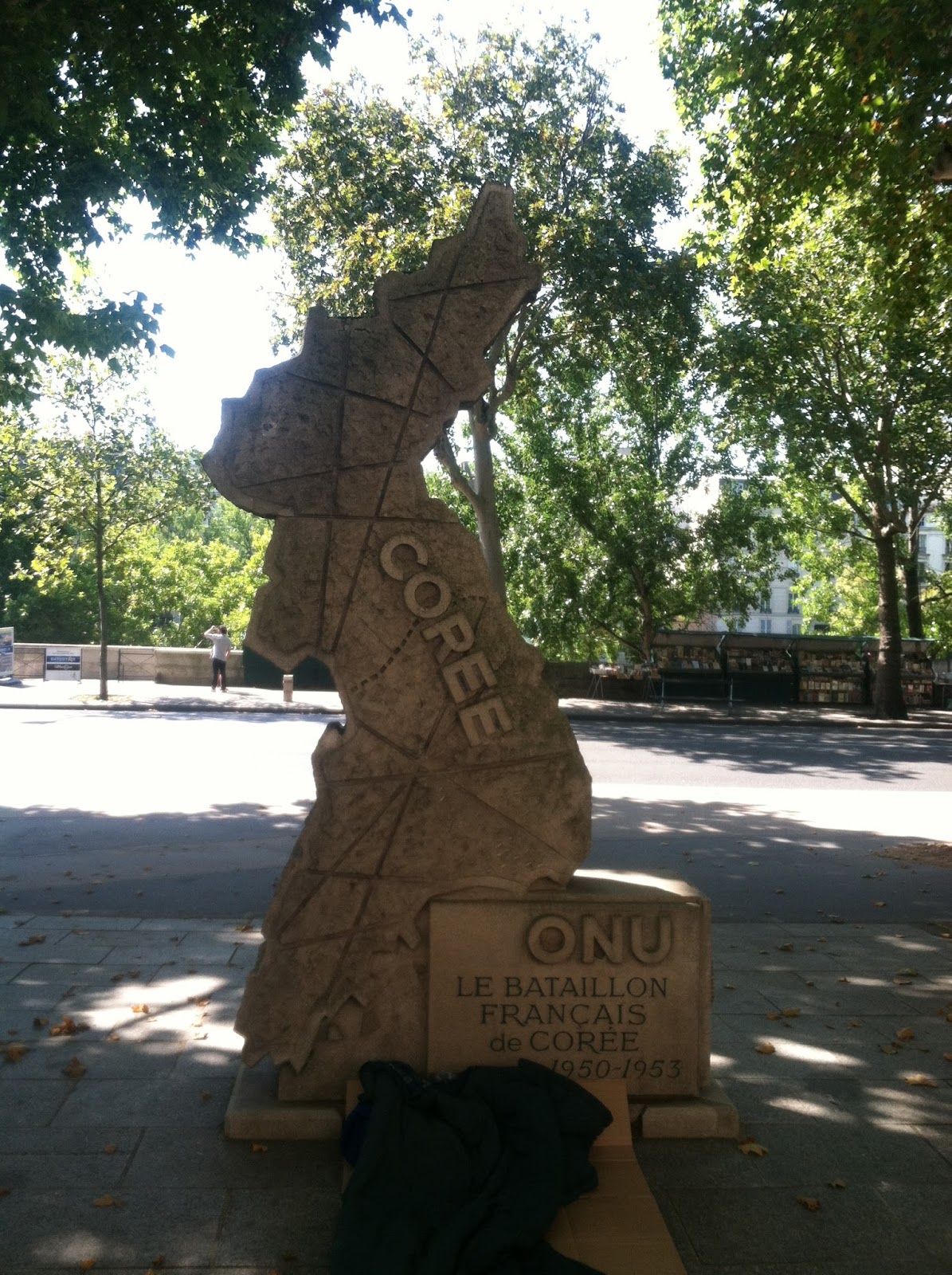
                       Stone Monument Honoring the French Battalion In Korea


France and the Forgotten War

The 60th anniversary of the Armistice ending the Korean War was commemorated recently, especially among the combatants countries who fought in the sanguinary conflict between 1950 and 1953.

 America lost 50,000 soldiers in what is known as the Forgotten War. Among over fifteen other countries which provided troops to the United Nations operations, France too has remembered this struggle which was sandwiched between WWII and the Indochina War.

For the record France sent a Battalion of volunteers to Korea to help stem the communist assault on the South.  The French Battalion arrived in country in November 1950 and was under the operational command of the U.S. 2nd Infantry.

French units participated in some of the most savage fighting in Korea and took heavy losses.  Of the 3,421 French serving in Korea, 287 were killed and an further 1,350 wounded.

Following service in South Korea, the Battalion was sent to active duty in Indochina where it took heavy losses in the closing stages of the French conflict in Vietnam. The unit would later serve in Algeria in a counterinsurgency mode against nationalist insurgents until 1962.

Today few French or Americans recall the role of the French Battalion in Korea, save for a small monument here in Paris on the banks of the Seine River.


Friday, August 9, 2013

Comment du Jour


Springtime for Qatar in Paris?

A Qatari investment group has bought the Printemps Department store in Paris.  The landmark property is the most recent acquisition for the petroleum rich kingdom who already owns some well-known hotels in Paris, among them the Royal Monceau.

Besides the Printemps store on Boulevard Haussmann in  Paris, the department store owns 16 stores throughout France.

The French media has been increasingly critical of Qatar, an Arab Gulf  Kingdom which has shown a high political and business profile in Europe.  


Sunday, August 4, 2013

Comment du Jour


Bonjour From France!!!

Despite lovely weather, it's the Summer of discontent. Socialist President Francois Hollande
is straddled with a 10.8 percent unemployment rate--the numbers are soaring among youth.

Pundits expect the rate to climb to 11 percent.  

The French shrug it off, for now, and go on vacation!!