Saturday, July 7, 2018
Comment du Jour
World Cup
Final Four Countdown
The FIFA World Cup of Football in Russia has been riveting and full of surprises.
Least of which is that most of the favored National Teams fell by the wayside
early on in the series. Germany, Argentina, Spain, Portugal, Brazil and Uruguay.
In most cases the "experts" were wrong and the favorites tumbled.
Others such as Japan, Sweden and Mexico played well but fell short too.
What we have now are two strong teams France and England as well as two
very unexpected but equally tough contenders; Belgium and Croatia.
All four challengers are European Union members; two Britain and Belgium are monarchies too.
England's smooth and spirited win against Sweden and Croatia's breathtaking
penalty kick victory over Russia set the tone for yet more surprises.
EXPECT the UNEXPECTED!!!
Don't count out Belgium nor Croatia.
On 15 July in Moscow, the World Cup is decided.


Saturday, June 16, 2018
Comment du Jour

The FIFA Football (soccer) World Cup has opened in Russia.
For a month, matches will take place across Russia in the
quest to win the coveted World Cup in the Finals in Moscow.
But as the German business newspaper Handelsblatt states
the World Cup is all about Money and Games. I might add
Politics too!
Friday, June 1, 2018
Comment du Jour

Stubbing America’s Toe on Steel Tariffs
Tariffs are in a sense like other taxes; easy to impose, hard to roll back,
and usually employed for the “greater good.” Thus triggering tariffs creates a feel good solution, a political sugar rush, but often later a bitter backlash to those ordering them.
I feel that the Trump Administration’s decision to slap steel and aluminum tariffs on many of our global trading partners admirably makes the populist political case but misses the mark when it comes to practical economic effect and intended outcome. There’s no doubt American steel industries have been devastated for a generation by cheaper foreign imports.
Equally, the overall trade playing field has not been even for the USA.
American industrial workers have paid the bitter price with job losses from Pennsylvania to Illinois.
That’s why I have long supported Free trade, but Fair trade. Fair has been missing for a long time.
Steel tariffs of 25 percent will be slapped on countries which have flooded the American market with cheaper steel. China comes to mind with its overproduction and underpricing. But ironically it emerges that while China has become a huge global steel producer, it is not even in the top five countries exporting steel to the U.S. market!
America’s top steel imports come from Canada, Mexico and the European Union, all including our closest allies and trading partners.
Canada and the Europeans, rightly upset, have vowed to retaliate in moves which could lead to a trade war.
Steel and aluminum clearly have a strategic component which is largely overlooked. The American steel industry was part of what President Franklin D. Roosevelt called the Arsenal of Democracy which helped win WWII.
Cities like Pittsburgh became the epicenter of production and prosperity. In 1952, a steel strike shutdown the industry confronting President Harry Truman with a major national crisis. But today would we even notice an American steel strike?
In the great steel town of Bethlehem, PA the mills are now closed replaced with bling bling casinos. Since the 1960’s the USA lost over 400,000 jobs in the steel industry. In the meantime, for the current 140,000 American steel workers, productivity has increased fourfold given technological innovation.
Indeed the tariff impulse is as old as the American Republic; Presidents Abraham Lincoln and William McKinley favored the measures. The Republican Party and the Democrats have both embraced and shunned tariffs over the past century. Recently, GOP House Speaker Paul Ryan and the Republican establishment firmly opposed Trump’s tariffs. Ironically, many Democrats support them.
Surprisingly America’s steel imports comprise only about 2 percent of U.S. trade; yet the symbolism and perception far outweighs the seemingly small numbers. Symbolism creates misperceptions.
In the past twenty years, President George W. Bush slapped tariffs on steel while Barack Obama imposed tire tariffs on China. Protectionism creates a feel good solution which in the short term helps and in the long term raises cost, cuts choice, stifles competition and creates the conditions for global mistrust and turmoil.
Witness some European Union countermeasures to punish American states which voted for Trump; Wisconsin’s Harley Davidson motorcycles or Kentucky’s Jim Beam Bourbon. It’s a sandbox game of getting even ironically despite a growing U.S. and global economy.
Addressing the specific NAFTA issue, Canada’s Foreign Minister Chrystia Freeland views trade pacts as a “win-win” and not “a Zero-sum game; one guy wins one guy loses.” She stressed, “We really sincerely think a trade relationship is a Win-Win.”
When viewing the ultimate cost and effect of tariffs, the noted economist Milton Friedman put it best, “The benefits of a tariff are visible. Union workers can see they are ‘protected.’ The harm which a tariff does is invisible. It’s spread widely. There are people that don’t have jobs because of tariffs but they don’t know it.”
The game is on.
Wednesday, May 30, 2018
Comment du Jour

Palais Coburg, Vienna, site of the Iran Deal negotiations in 2015
Iran Deal’s Billion Dollar Questions
Just days after the global sigh of relief regarding the upcoming United States/North Korea Summit, world opinion swung back into bitter criticism over the Trump Administration’s announcement that it was scrapping America’s participation in the Iran Nuclear Deal, the penultimate diplomatic legacy of the Obama Administration.
Indeed the biggest political pushback to Trump’s widely anticipated policy turnaround was from Western Europe, not the Middle East nor China. The U.S. decision is supported by a curious group of friends including Israel, Saudi Arabia, and most Arab countries.
The Iran Deal as it is known, was framed by the five Permanent members of the UN Security Council; China, France, Russia, the United Kingdom, the United States as well as Germany to presumably contain what was a dangerously expanding nuclear weapons research and development program by the Islamic Republic of Iran. Keeping Iran from getting nuclear weapons was the goal of the agreement. Officially known as the Joint Comprehensive Plan of Action (JCPOA), the deal would theoretically keep Teheran’s nuclear weapons ambitions “in the box.”
Crafted in Vienna’s stunningly stately but small Palais Coburg, the “Deal” reached in 2015 was actually an Obama Executive Agreement and not a Treaty and thus circumvented U.S. Senate approval, which it would never have gained.
Once the ink had dried, economic sanctions on Islamic Iran were lifted by the United States
and the Europeans. Before long, European businessmen were flooding the Iranian capital Tehran in search of their own commercial Deals. The Americans soon followed.
Prior to the tougher economic sanctions on Tehran in 2012, the European Union states were
Iran’s biggest trade partner. U.S. relations remain rooted in the poisoned ties between Washington and Tehran since 1979 and the seizure of the American Embassy as well as the nuclear crisis.
Yet by 2017 European Union exports to Iran reached $13 billion with imports from the Islamic Republic worth $12 billion. Predictably most EU imports are energy related.
China, the European Union and India remain Iran’s primary trading partners.
France’s Total Oil has signed accords of $5 billion to help develop the world’s largest gas field.
Equally Renault auto will expand current co-production in Iran to boost output to 350,000 vehicles annually. The Franco/German consortium Airbus planned to sell 100 civilian airliners to Iran.
Late in the Obama Administration, Boeing had inked plans to sell over 100 jets to Iran’s civilian
Airlines in a highly controversial move which has since been stopped.
Yet the lure of Europe’s $25 billion two way trade with Islamic Iran starkly contrasts with the EU’s $755 billion trade with the USA. Stated another way, the annual EU/Iran trade equals about two weeks worth of U.S. trade with China!
Many major Western European companies viewed Islamic Iran as a potential commercial bonanza, as it was in the period prior to the so-called Islamic Revolution in 1979, have been deeply disappointed. Still the European powers remain politically vested in the agreement.
Transatlantic Ties are being strained yet again, this time not over NATO budget shortfalls, but the fact that Washington will revive economic sanctions on Iran which not only forbids American companies, but may bar foreign firms from investing and trading with the Islamic Republic.
So-called “secondary sanctions” could affect European companies in six months.
Monday, April 30, 2018
Comment du Jour

Macron U.S. Visit Stresses Shared Values, Security
What’s best described as a budding bonhommerie, or a “bromance” to put it into the Anglovernacular, seemed to unite the two political leaders during the lavish visit. This is more than a cosmetic show of friendship but an ambitious move by Macron to balance his European Union commitments along with his cherished transatlantic instincts.
Amid hugs and handshakes, there’s an interesting political chemistry between Macron and the Donald, both political outsiders and mavericks who enjoy ruffling feathers and challenging the status quo. In many ways, Trump (71) may see the young Macron (40) as the age of his son. Neither man is a political philosopher but rather a practical if determined practitioner.
While most of the mainstream media revel to stress points of disagreement between both presidents, such as climate change, the flawed Iran nuclear deal, and trade tariffs, it’s only natural and not surprising that friends and indeed sovereign nations are not precisely on the same page on each and every issue.
In an impassioned address to the U.S. Congress, President Macron stated clearly, “The strength of our bonds is the source of our shared ideals.”
He added “This is what united us in the struggle against imperialism in the First World War. Then in the fight against Nazism in the Second World War. This is what united us again during the era of the Stalinist threats and now we lean on that strength to fight against terrorist groups.”
President Macron added poignantly, “Since 1776, we, the American and French people, have had a rendez-vous with freedom. And with it come sacrifices.”
Saturday, March 31, 2018
Comment du Jour

Hungary Calls for Baby Boom to Offset Demographic Decline
“Migration is not the solution to demographic problems,” warned Katalin Novak, Hungary’s Minister of State for the Family. Though conceding the European continent faces a significant “demographic decline” and the undertow of a falling population, individual states can counter the “inevitability” through focused family friendly policies such as those being pursued in her Central European country.
“In Europe we face population decline, and imagine in the European Union there is not a single Member state where the fertility is sufficient to maintain the population. In each and every member state it is below 2. It is as if we have lost our capacity to maintain our population. That is also the situation in Hungary with a population decline since 1981. Thus for three and one-half decades we have lost over ten percent of our population, approximately 850,000 people.”
In an interview with this correspondent, Minister Novak, the highest ranking woman in the center-right Hungarian government speaks proudly as the mother of three children. She was visiting the UN for activities related to the Commission on the Status of Women.
Hungary’s population is below ten million. “At the lowest in 2011 the fertility rate was 1.23 now it’s 1.5, “ said Novak, adding, “But you know what we inherited is very hard to overcome. In Europe many leaders speak of migration, ‘Europe is the continent of empty cradles, so why not bring in migrants?’ But Hungarians are not ready to do this. When you ask young people, they say they want to get married and to have children.”
The European statistics agency Eurostat says that 1.58 remains the EU average fertility rate.In Germany the rate is 1.5, in Italy 1.35 and in Spain 1.3.
So what are the Budapest government’s goals? She stressed, “The goal is 2.1.” But when asked if this is too ambitious she retorted, “If you start by Plan B, you will fail. You have to have ambitious goals so that you can really overcome this situation. We have made progress. In just six years the fertility rate has increased by 20 percent.”
Minister Novak concedes that Hungary aims at reaching the target through Family Friendly programs of financial aid and stressing the benefits of Family Life.
Significantly, she stressed that her government has earmarked 5% of GDP for a wide range of Family Policy initiatives. The spending is two times the OECD average. “This is not spending really but actually an investment in our Nation,” she added.
“Young people get married quite late as well. Between 2002 and 2010 the marriage rate decreased 23 percent but since 2010 now it has increased almost 43 percent. “We have value based policies. Being neutral is not a value. You have to hold to values.We are a value based government,” she asserted.
A stubbornly high abortion rate during the old regime caused a notable population decline. When asked whether abortion remains widespread Minister Novak conceded “It has dropped a lot but… I believe one abortion is too much. In Hungary abortion is legal under circumstances but in our Constitution it is stated that ‘Life begins at the moment of conception.’ The life of the fetus should be protected. We protect Human life from conception.” She stressed, “There are still too many abortions which remains a challenge for us. The Abortion rate is still 31/100. It was higher during communist times.”
Minister Novak concluded, “We are a Family Friendly country, that is a concept we are trying to introduce. We must show the joy and happiness of child raising.”
Wednesday, March 14, 2018
Comment du Jour

The stunningly beautiful New York Antiquarian Book Fair has again reached new
heights of excellence and participation. The 58th annual event at the Park Avenue Armory
brought together more than 200 American and international sellers in a setting that was
as splendid as it was interesting.
Rare historic selections as well as more recent books of note were among the offerings which also included maps, autographs, and prints.


JF Letenneur Rare Books of Saint Briac sur Mer, France, a perennial show favorite returned.
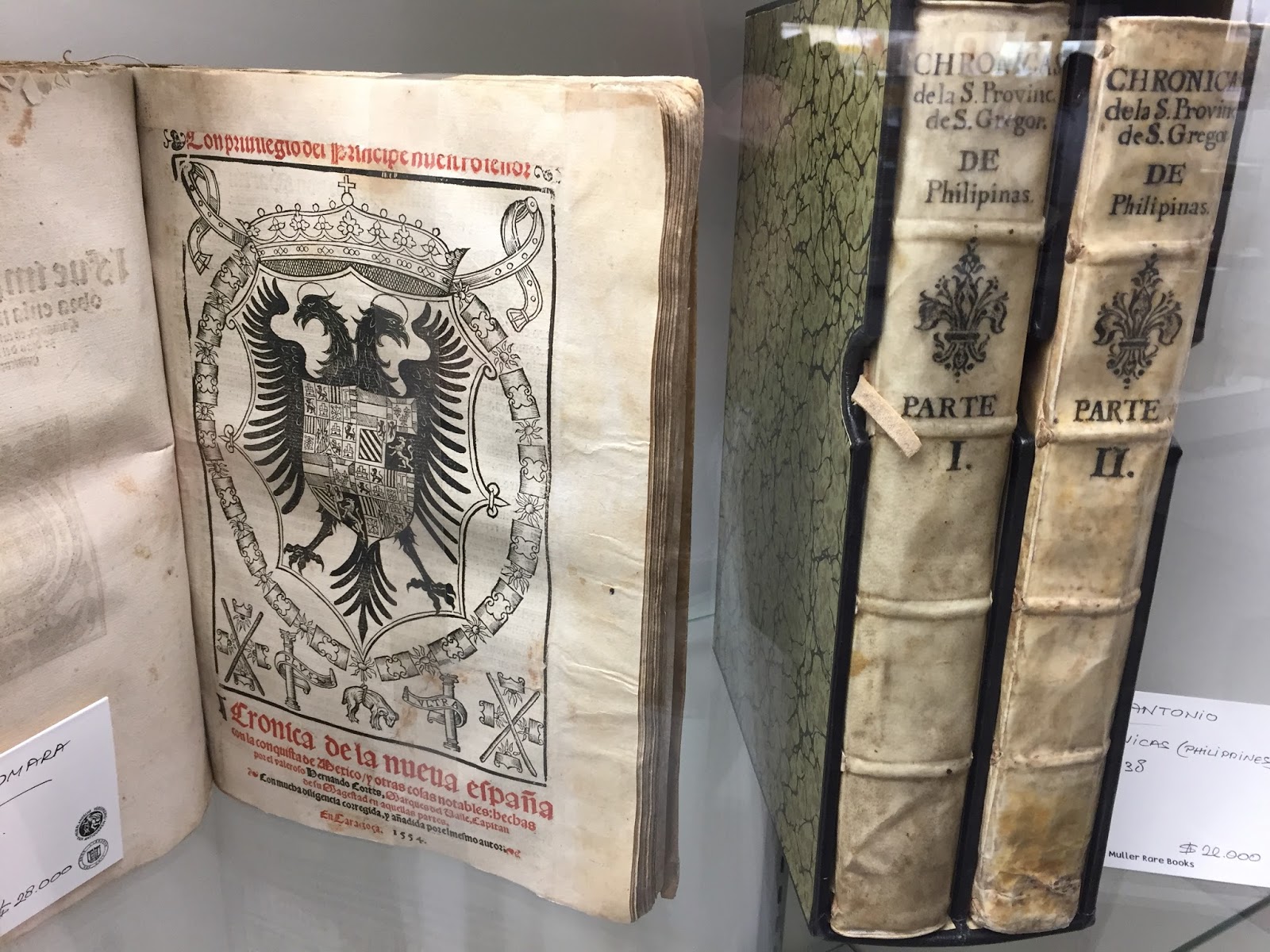
Frederik Muller a renown Dutch dealer was back too!

Seth Kaller Historic documents of Westchester, NY brought a Draft of President George Washington's First Inaugural Address from 1789!!

Lionheart Autographs of New York City offered a rare Walt Whitman photo.
Indeed the show offered a plethora of quality dealers such as favorites Leo Cadogan of London, the perennially popular Asia Bookroom from Canberra, Australia, Buddenbooks of Newburyport, MA and Antiquariat Kainbacher of Baden, Austria joined dealers from Britain, France, Germany, the Netherlands, Japan and Russia.

Until nextYear!!!
Subscribe to:
Posts (Atom)